
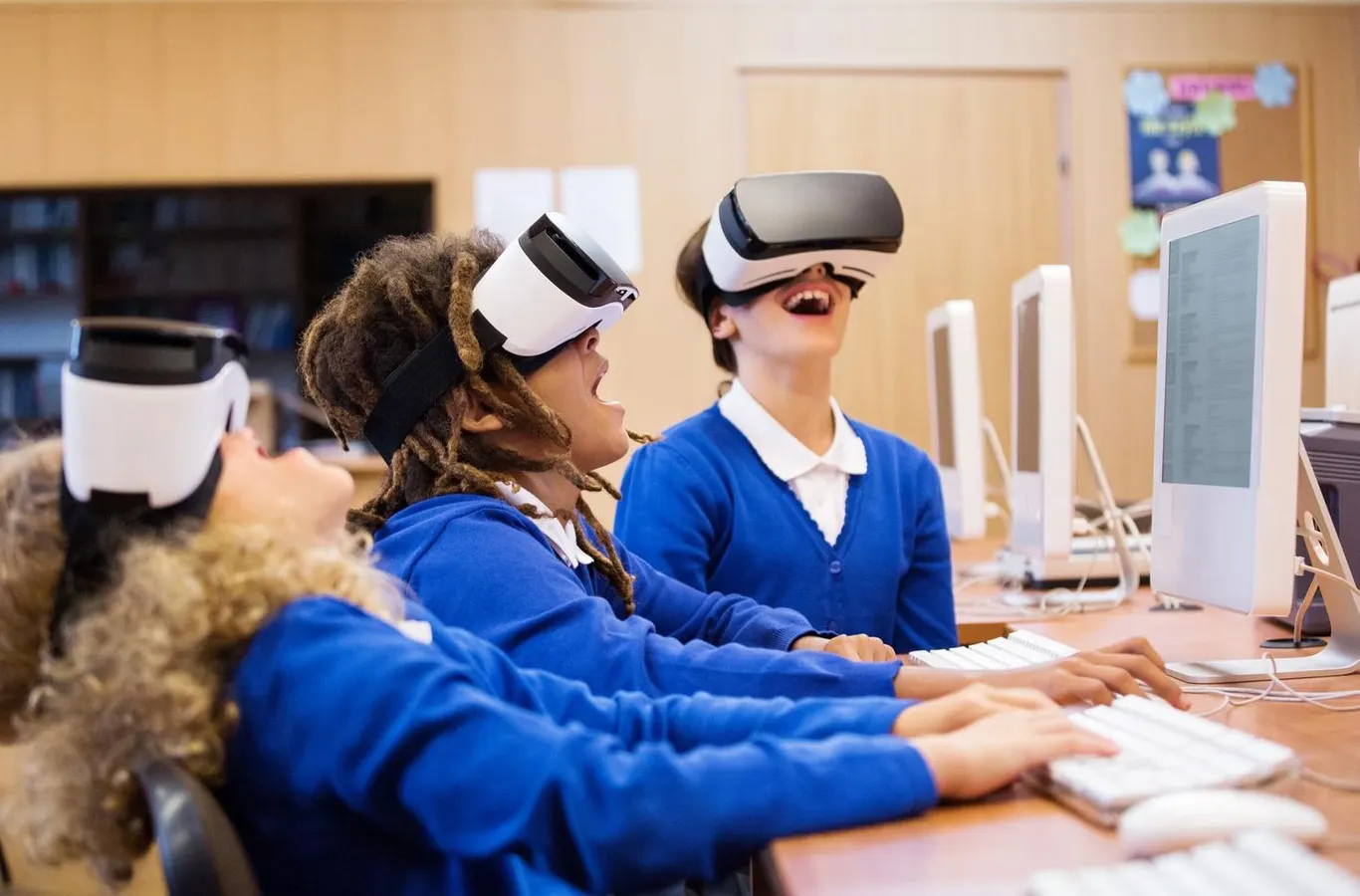

Virtual Reality (VR) in education is reshaping how students learn by turning traditional lessons into immersive experiences. Instead of only reading about concepts, learners can explore environments, interact with simulations, and visualize complex ideas in three-dimensional space. This approach improves understanding, engagement, and retention across different levels of education.
As schools, universities, and training institutes adopt digital learning technologies, VR is becoming a powerful tool that supports interactive and practical learning beyond classroom boundaries.
What Is Virtual Reality in Education?
Virtual Reality in education refers to the use of computer-generated 3D environments that allow students to explore subjects through immersive experiences. With VR headsets and compatible software, learners can interact with simulated environments as if they were physically present inside them.
For example:
- Visiting historical landmarks without traveling
- Exploring the human body in 3D
- Conducting science experiments safely in virtual labs
- Practicing technical skills in simulated workplaces
This method transforms passive learning into active participation, improving both attention and understanding.
Importance of Virtual Reality in Modern Learning
Traditional teaching methods sometimes limit students’ ability to visualize abstract or complex topics. VR bridges this gap by making lessons experiential and engaging.
Key benefits include:
- Better concept visualization
- Increased student motivation
- Improved memory retention
- Safe practice environments
- Equal learning opportunities regardless of location
Because of these advantages, VR is increasingly becoming part of digital classrooms worldwide
Applications of Virtual Reality in Education
VR technology supports learning across multiple academic disciplines and professional training areas.
Science Education
Science subjects often involve complex structures and processes that are difficult to imagine through textbooks alone.
VR helps students:
- Explore molecules and atoms in 3D
- Observe planetary systems interactively
- Conduct laboratory experiments virtually
- Understand biological structures clearly
This makes science more accessible and engaging for learners at all levels.
Medical Training
Medical education benefits significantly from VR-based simulations. Students can practice procedures repeatedly without risk to real patients.
Common uses include:
- Surgical simulations
- Anatomy visualization
- Emergency response training
- Clinical decision-making practice
Such simulations improve both confidence and accuracy before real-world application.
History and Geography Learning
VR enables students to travel through time and space virtually.
Examples include:
- Visiting ancient civilizations
- Exploring historical battlefields
- Touring world heritage locations
- Observing geographical formations closely
This immersive approach strengthens contextual understanding of global events.
Technical and Skill-Based Training
Vocational education and professional training programs use VR to simulate real working environments.
Students can practice:
- Machine handling
- Engineering simulations
- Construction site safety
- Aviation procedures
These experiences reduce training risks and improve practical readiness.
Language Learning
Language education becomes more interactive when learners practice conversations in virtual environments.
Benefits include:
- Realistic communication scenarios
- Cultural exposure through simulations
- Improved pronunciation practice
- Increased learner confidence
This approach supports faster language acquisition compared to traditional memorization methods.
Advantages of Virtual Reality in Education
VR offers several advantages that enhance both teaching effectiveness and learning outcomes.
Major advantages include:
- Encourages experiential learning
- Supports personalized education pace
- Improves focus and classroom participation
- Enables remote access to complex environments
- Reduces dependency on physical learning resources
Students often become more enthusiastic when learning feels interactive rather than repetitive.
Challenges of Implementing Virtual Reality in Education
Despite its benefits, VR adoption still faces some practical limitations.
Common challenges include:
- High equipment costs
- Technical infrastructure requirements
- Teacher training needs
- Limited content availability in some subjects
- Possible screen-time concerns for younger learners
However, as technology becomes more affordable, these challenges are gradually decreasing.
Role of Teachers in VR-Based Classrooms
Teachers remain essential even in technology-driven learning environments. VR supports instruction but does not replace educators.
Teachers help by:
- Selecting appropriate VR content
- Guiding student interaction
- Explaining complex concepts after simulations
- Monitoring student engagement
- Connecting virtual experiences with real-world understanding
Effective teacher involvement ensures that VR enhances rather than distracts from learning.
Future Scope of Virtual Reality in Education
The future of VR in education looks promising as institutions continue adopting digital transformation strategies.
Emerging developments include:
- AI-supported immersive classrooms
- Virtual campus environments
- Collaborative global learning spaces
- Career-focused simulation labs
- Inclusive education for differently-abled learners
As access improves, VR is expected to become a regular part of modern educational systems
Tips for Students Using Virtual Reality for Learning
Students can maximize VR learning benefits by following practical strategies.
Helpful tips include:
- Focus on learning objectives before entering simulations
- Take notes after immersive sessions
- Avoid excessive usage without breaks
- Combine VR learning with textbooks and discussions
- Practice regularly for better skill development
Balanced usage ensures effective learning outcomes.
Frequently Asked Questions (FAQs)
1. Is virtual reality suitable for primary school students?
Yes, age-appropriate VR content designed for young learners can improve engagement and make foundational subjects easier to understand.
2. Do students need expensive equipment to access VR learning?
Not always. Some institutions provide shared VR labs, and affordable smartphone-based VR solutions are also available.
3. Can virtual reality replace traditional classrooms completely?
No. VR enhances classroom learning but works best when combined with teacher guidance and structured lessons.
4. Is virtual reality useful for distance education programs?
Yes, VR supports remote learners by providing immersive experiences that simulate real classroom and laboratory environments.
5. Does virtual reality improve exam performance?
It can improve conceptual clarity and memory retention, which often contributes to better academic performance.
6. Are there health risks associated with prolonged VR use?
Extended usage without breaks may cause eye strain or discomfort, so sessions should be used responsibly and in moderation.
7. Which subjects benefit the most from VR-based learning?
Science, medicine, engineering, geography, and history benefit significantly due to their strong visual and practical learning requirements.